Marketplace Logo

Welcome to the platform security guide — the complete resource for anonymous marketplace access and verified link authentication. Learn essential practices for secure market navigation, PGP encryption, Tor Browser configuration, and operational security in darknet environments.

Understanding the Marketplace Security in 2025

In the rapidly evolving landscape of darknet marketplaces, the market has established itself as a specialized platform emphasizing security, vendor verification, and user protection. As one of the boutique darknet markets operating in 2025, the marketplace implements rigorous security protocols including mandatory PGP encryption, two-factor authentication, and complete escrow systems. Understanding how to safely access and navigate the market requires knowledge of fundamental privacy technologies and operational security practices.

marketplace security architecture is built on proven cryptographic foundations. The platform shifted to Monero (XMR) as its primary cryptocurrency in 2024, recognizing the superior privacy guarantees of Monero's ring signatures and stealth addresses compared to Bitcoin's transparent blockchain. This decision aligns the marketplace with industry best practices for financial privacy, ensuring that transaction histories cannot be traced through blockchain analysis. All marketplace communications require PGP encryption, and the platform implements strict vendor verification processes to maintain quality standards and user safety.

This complete guide provides educational resources for understanding privacy technologies essential for the marketplace access and similar darknet platforms. Whether you're researching marketplace security implementations, learning about anonymous communication protocols, or seeking to understand how platforms like this platform protect user privacy, this resource offers verified information from trusted cybersecurity experts and privacy advocates. Official platform links and mirrors are available through our verified access page, authenticated through PGP signatures and real-time status monitoring.

Current Cryptocurrency Prices

Real-time cryptocurrency market data for the marketplace and anonymous transactions. Prices updated every 60 seconds from CoinGecko API.

Monero (XMR)

$Loading...
Loading...
24h Volume: $--
Updated: --:-- UTC

Bitcoin (BTC)

$Loading...
Loading...
24h Volume: $--
Updated: --:-- UTC

Ethereum (ETH)

$Loading...
Loading...
24h Volume: $--
Updated: --:-- UTC

Data Source: Real-time prices from CoinGecko. Market prices may vary across exchanges. Always verify current rates on the platform before executing transactions.

Tor Network: Essential for Marketplace Access

🌐

Understanding Tor Architecture for DrugHub Access

The Tor network (The Onion Router) is the mandatory access method for the marketplace and all darknet marketplaces. Developed by the nonprofit Tor Project, this technology enables millions of users worldwide to access hidden services like this platformplace without revealing their location or identity. Understanding Tor fundamentals is essential for secure marketplace navigation.

Tor works by routing internet traffic through three randomly-selected volunteer-operated relays: an entry node, middle node, and exit node. When accessing the platform through Tor Browser, your connection passes through these relays with multi-layered encryption. Each relay only knows about the relay immediately before and after it, making it nearly impossible for any entity to trace the complete path to the platformplace. This onion-routing approach provides strong protection against traffic analysis and network surveillance.

The Tor Browser, based on Firefox, comes pre-configured for accessing the platform safely. It automatically routes all traffic through the Tor network, blocks tracking technologies, and includes NoScript for JavaScript control. For maximum security when accessing the platformplace, configure security level to "Safest," which disables JavaScript execution on most sites. While this may break some functionality, it significantly enhances protection against browser-based attacks.

the market operates as a Tor hidden service with a version 3 onion address—websites that exist only within the Tor network and cannot be accessed through regular browsers. the onion addresses use 56-character v3 format, offering enhanced security with improved cryptographic protection compared to older v2 addresses. These hidden services provide additional anonymity because they don't require exit nodes, eliminating a potential monitoring point in the connection chain to the platformplace.

🛡️

Tor Browser Configuration for Marketplace

Proper Tor Browser configuration is critical for maintaining anonymity when accessing the platform. Download Tor Browser exclusively from the official Tor Project website—never use third-party sources, as compromised versions could expose your marketplaceplace activity. The default installation provides good security, but additional hardening measures significantly improve protection for the marketplace access.

Essential Security Settings for Marketplace: Set security level to "Safest" by clicking the shield icon and choosing maximum protection. This disables JavaScript by default, prevents automatic media playback, and applies strictest content policies. Never resize the Tor Browser window manually when accessing the platformplace, as unique window dimensions enable browser fingerprinting. The browser starts in standard size specifically to prevent this tracking method.

Operational Security Rules for the Marketplace: Never log into personal accounts while accessing the platform through Tor Browser. Don't install browser extensions or plugins when using Tor to access the marketplace, as these can compromise anonymity. Avoid downloading files from the marketplace whenever possible—documents may contain tracking elements or connect back to the internet when opened outside Tor Browser, potentially exposing your real IP address.

For users requiring the highest anonymity level when accessing the platform, consider using Tails OS (The Amnesic Incognito Live System). Tails routes all connections through Tor by default and leaves no trace on the computer. It runs from a USB drive and automatically wipes all session data upon shutdown, making it ideal for the marketplaceplace access when leaving no digital footprint is paramount. Many platform users prefer Tails for its complete security approach.

PGP Encryption: Required for Marketplace Communication

the market requires PGP (Pretty Good Privacy) encryption for all sensitive communications. Understanding PGP is mandatory for the marketplaceplace participation and essential for anyone serious about protecting sensitive communications.

🔐

PGP Fundamentals for the Marketplace

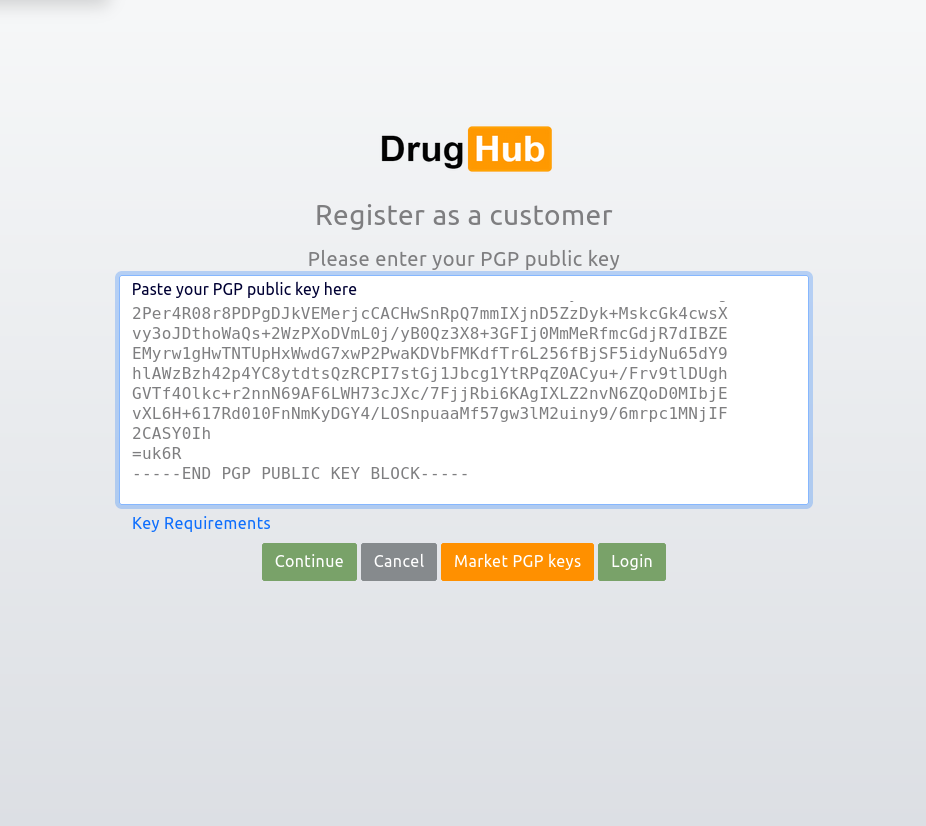
PGP (Pretty Good Privacy) is the cryptographic system used by the market for encrypting messages and verifying identities. the marketplace implements mandatory PGP encryption, meaning users cannot participate without setting up PGP keys. The system uses asymmetric encryption: you have a public key that you share (including with the market vendors), and a private key that you keep secret and never share under any circumstances.

When communicating on the platform, other users encrypt messages using your public key. Only your private key can decrypt these messages—even the sender on the platformplace cannot decrypt what they've encrypted with your public key. This elegant system ensures that even if marketplace communications are intercepted, the contents remain secure. Conversely, you can digitally "sign" platform messages with your private key, and others can verify the signature using your public key, confirming message authenticity.

Modern platform users employ the OpenPGP standard, with the most popular free implementation being GnuPG (GPG). For graphical interfaces, Gpg4win (Windows) and GPG Tools (macOS) provide user-friendly PGP management for the marketplaceplace communication. These tools handle key generation, encryption, decryption, and signature verification through intuitive interfaces suitable for the marketplace users.

Key Generation for Marketplace: When creating PGP keys for the marketplaceplace, use RSA encryption with at least 4096-bit key length for maximum security. Choose a strong passphrase for your marketplace PGP key—this passphrase protects your private key file. Your passphrase should be long (20+ characters), complex, and memorable only to you. Store your marketplace private key securely with encrypted backups. If you lose your private key, any the marketplace data encrypted with your public key becomes permanently inaccessible.

✅

Using PGP for Marketplace Authentication

Beyond encrypting the market messages, PGP serves critical role in verifying authenticity—confirming that official platform communications genuinely come from trusted sources and haven't been tampered with. the market publishes official announcements with PGP signatures. When you see a PGP-signed platform message, you can verify it against the official platform marketplace public key to ensure legitimacy and detect phishing attempts.

Signature Verification for the Marketplace: To verify a signed the market message, you need the official platform marketplace public key (available from officially verified sources). Import the the market public key into your PGP client, then verify signatures on any message claiming to be from the marketplaceplace. A valid signature confirms two things: the message was created by someone with access to the platform's private key, and the content hasn't been modified since signing. Invalid signatures indicate phishing or tampering—never trust unverified platform communications.

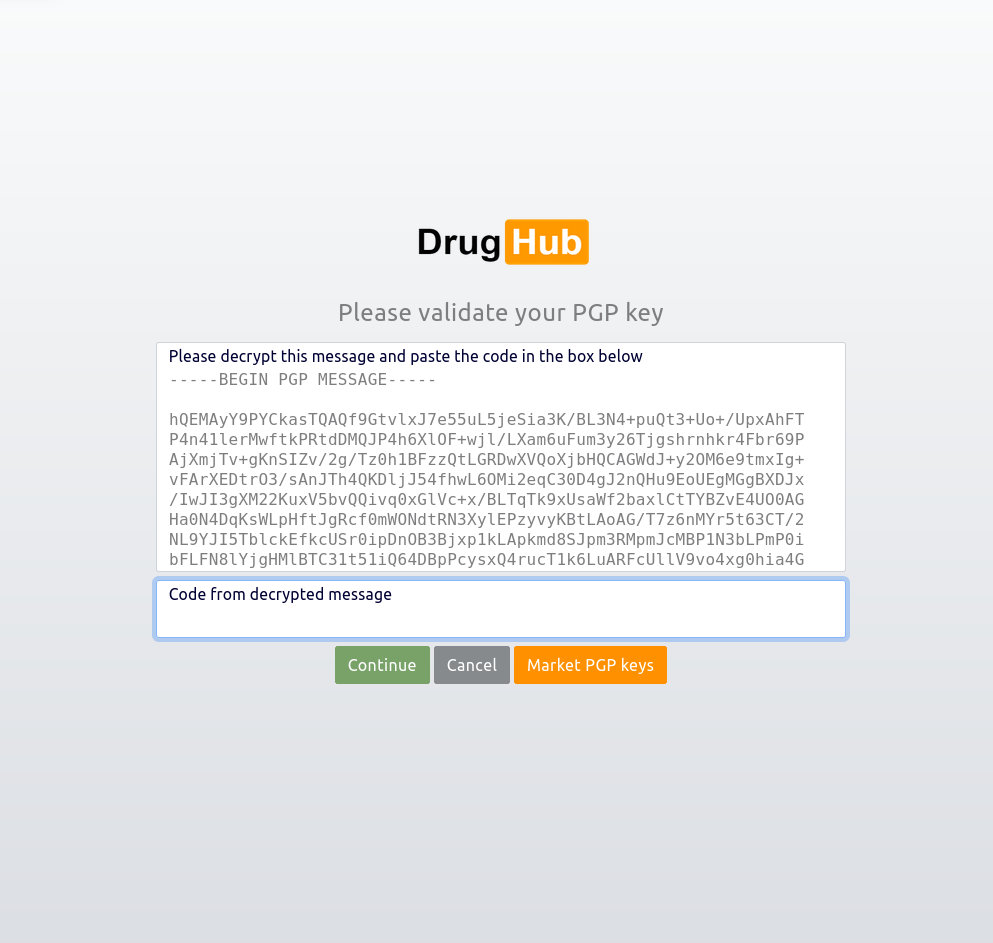
Two-Factor Authentication on DrugHub Market: the marketplace implements PGP-based two-factor authentication (2FA), where users must decrypt a challenge encrypted with their public key and respond correctly. This proves possession of the private key without revealing it. This marketplace 2FA method is more secure than SMS-based alternatives (vulnerable to SIM swapping attacks) and comparable to hardware token security while being completely software-based.

Learning resources for PGP are available from the Electronic Frontier Foundation's Surveillance Self-Defense guides and Email Self-Defense tutorial by the Free Software Foundation. These guides provide step-by-step instructions for setting up PGP for the marketplace access, generating keys, and encrypting your first the marketplace messages. While PGP has a learning curve, mastering it is mandatory for the marketplace participation and provides unparalleled communication security.

Cryptocurrency Privacy: DrugHub Market Payment Methods

the platform's decision to implement Monero-only transactions in 2024 reflects the marketplace's commitment to user privacy. Understanding cryptocurrency privacy characteristics is essential for anyone using the platform or similar platforms. While Bitcoin popularized blockchain technology and remains accepted on some markets, its transparent ledger means all transactions are permanently visible on the public blockchain, creating significant privacy concerns for the marketplace users and darknet marketplace participants.

Bitcoin Privacy Challenges for Marketplace Users

Bitcoin operates on a transparent blockchain where every transaction is publicly recorded forever. While Bitcoin addresses don't directly reveal identity, sophisticated blockchain analysis can often link addresses to individuals through patterns like transaction timing, amounts, and connections to known entities like exchanges that collect KYC information. Law enforcement and private companies employ blockchain analysis tools capable of tracing Bitcoin transactions with high accuracy, making Bitcoin suboptimal for the marketplace and similar marketplace transactions.

Privacy-conscious Bitcoin users employ several strategies to enhance anonymity. CoinJoin services mix multiple users' transactions together, making it difficult to determine which inputs correspond to which outputs. Wasabi Wallet integrates CoinJoin directly into its interface. Address reuse prevention—using new addresses for each transaction—helps prevent linking multiple transactions to a single user. Running a full node prevents reliance on third-party servers that might log your IP address and link it to your Bitcoin addresses.

Despite these techniques, Bitcoin remains fundamentally transparent. Determined adversaries with sufficient resources can often trace transactions through Bitcoin's permanent record. This reality drove the platform's transition to Monero-only payments, recognizing that users requiring maximum financial privacy need cryptocurrencies specifically designed for anonymity rather than optional privacy features layered onto transparent blockchains.

Monero: Platform's Privacy-First Cryptocurrency

Monero (XMR) was designed from the ground up as a privacy cryptocurrency, implementing advanced cryptographic techniques that make transactions untraceable by default. the marketplace's adoption of Monero reflects industry recognition that privacy-by-default architecture provides superior protection compared to Bitcoin's optional privacy features. Unlike Bitcoin, where using privacy features makes users stand out, every Monero transaction is private automatically, eliminating the "anonymity set" problem.

the market benefits from Monero's three core privacy technologies: Ring Signatures hide the true sender by mixing each transaction with decoy transactions, making it impossible to determine which input is actually being spent. Stealth Addresses generate unique, one-time addresses for each transaction, preventing address reuse and ensuring recipients cannot be identified through blockchain analysis. Ring Confidential Transactions (RingCT) obscure transaction amounts, hiding both sender identity and value being transferred on the platformplace.

The combination of these technologies makes Monero transactions on the platform completely untraceable—blockchain analysis companies that successfully trace Bitcoin cannot follow Monero transactions. This privacy-by-default architecture explains why the marketplace and similar security-focused platforms prefer Monero, as recommended by privacy advocates and security researchers worldwide. The official Monero project provides complete documentation at getmonero.org, including wallet software compatible with the market transactions.


Password Management for Marketplace Accounts

Strong password practices form the foundation of your account security. Understanding password management is critical for protecting your marketplaceplace account and sensitive information.

🔑

Creating Strong Passwords for Marketplace

your account password strength directly correlates with security. Weak passwords—short passwords, dictionary words, personal information, or commonly-used patterns—can be cracked in seconds using modern password-cracking tools. the marketplace passwords must be long (16+ characters minimum), complex (mixing uppercase, lowercase, numbers, and symbols), and unique. Never reuse your marketplace password on other sites—if one site suffers a data breach, attackers could access your marketplaceplace account using leaked credentials.

Manually managing unique, complex passwords for the marketplace and other services is impossible for most people. This is where password managers become essential. KeePassXC is an open-source, offline password manager that stores all your passwords—including your marketplaceplace password—in an encrypted database protected by a single master password. You only need to remember one strong master password, and KeePassXC securely stores and auto-fills all other credentials including the market login details.

Master Password Best Practices for the Marketplace Access: Your master password must be exceptionally strong since it protects access to your marketplace password and all other credentials. Use a passphrase—a sequence of random words that's both secure and memorable. Alternatively, use a long random string of characters (20+ characters) stored in a secure physical location as backup. Enable two-factor authentication on your password manager if supported. Never share your master password or store it digitally in plain text, as this could compromise your marketplaceplace account.

🔐

Two-Factor Authentication for Marketplace

the market implements two-factor authentication (2FA) as a critical second layer of security beyond passwords. Even if your marketplaceplace password is compromised, attackers cannot access your account without the second factor. the market uses PGP-based 2FA, which is more secure than SMS-based alternatives. Understanding and properly configuring platform 2FA is essential for account protection.

Avoid SMS-based 2FA on any platform including marketplaces, as text messages can be intercepted through SS7 protocol vulnerabilities or SIM swapping attacks where criminals social-engineer phone providers to transfer numbers to their devices. the platform's PGP-based 2FA is significantly more secure, requiring you to decrypt a challenge using your private key. This proves you possess the private key without ever revealing it, providing phishing-resistant authentication for the marketplaceplace access.

Recovery Procedures for Marketplace: When enabling 2FA on the platformplace, ensure you understand the recovery process if you lose access to your 2FA method. the market provides recovery codes during 2FA setup—typically random strings you can use if you lose access to your PGP key. Store these the marketplace recovery codes securely, preferably printed and kept in a safe physical location. Without recovery codes or backup 2FA methods, losing your PGP key means permanent lockout from your marketplace account.

Operational Security (OPSEC) for Marketplace Users

🎯

Core OPSEC Principles for the Marketplace

Operational Security (OPSEC) refers to the systematic process of protecting sensitive information from adversaries. For platform users, OPSEC means protecting your identity, activities, and communications. The fundamental principle for the marketplaceplace users: assume adversaries are actively trying to compromise your security, and act accordingly. This mindset shift—from "I'm not important enough to target" to "I will protect my platform activity as if under surveillance"—dramatically improves security posture.

Key OPSEC Principles for Marketplace: Compartmentalization—separate marketplace activity from personal online identities completely. Never mix personal and the platform accounts. Use different browsers, email addresses, and ideally physical devices for the marketplaceplace access. Need-to-Know Basis—share information about the platform activity only with those who absolutely require it. Assume Compromise—plan as if your marketplaceplace security will be breached, and minimize damage through defense-in-depth strategies. Use full-disk encryption so stolen devices remain inaccessible. Leave No Trace—minimize digital footprints related to the platform by using privacy-focused tools, clearing cache/cookies regularly after the marketplace sessions, and avoiding services that log user activity.

Common OPSEC Failures for Marketplace Users: Discussing marketplace activity on social media, reusing usernames from other platforms on the platform, accessing the platformplace from identifiable locations without VPN before Tor, mixing personal and the platform identities, trusting too many people with the marketplace information, and failing to update security practices as threats evolve. Each failure creates potential vectors for identification. Successful marketplace OPSEC requires consistent application of security principles across all activities—a single mistake can compromise otherwise perfect security.

Recommended Security Resources & Privacy Tools

Essential privacy and security tools recommended for the marketplace access and general darknet marketplace security. All links lead to official project websites verified by cybersecurity experts.

Privacy & Security Organizations

Cryptocurrency Projects

Security & Encryption Tools

⚠️ Disclaimer: These are independent third-party tools and organizations recommended for the marketplace security. Always verify software integrity through official channels and PGP signatures before installation for the marketplaceplace use.

Navigate DrugHub Market Security Resources

Explore complete information about the platform platform, secure marketplace access, verified verified mirrors, and detailed security implementations through official resource pages.

01

About the Platform Platform

Learn about the platformplace features, security architecture, vendor verification systems, and operational guidelines. The about page provides detailed information about the platform implementations and security protocols for marketplace participation.

View About the Platform →
02

Access Verified Verified Mirrors

Access current official platform marketplace mirrors with real-time status monitoring, PGP verification information, and step-by-step connection instructions. All official links are verified and updated regularly.

View Verified Access →

🕒 Page last updated: